

Cybersecurity is now a practical operating requirement for small businesses. Phishing, credential theft, ransomware, and supplier compromise can affect organisations of any size, while smaller teams often have less time and specialist capacity to respond.
In this guide, we break down the most important cybersecurity steps every Perth business should take, explain the threats you face right now, and show you how partnering with a local Managed Service Provider (MSP) can protect your livelihood.
Why Perth Small Businesses Are Being Targeted
Western Australia’s business community is thriving — from trades and construction to professional services and retail. But this growth has made us a target. Cybercriminals use automated tools to scan thousands of businesses simultaneously, looking for any weakness they can exploit. They don’t care whether you’re a two-person accountancy firm or a 50-person logistics company.
The most common threats facing SMBs today include:
- Fraudulent emails designed to steal login credentials or trigger fraudulent payments
- Phishing emails
- Malicious software that encrypts your files and demands payment for their return
- Ransomware
- Attackers impersonate your CEO or supplier to redirect payments
- Business Email Compromise (BEC)
- Using leaked usernames and passwords to access your accounts
- Credential stuffing
- Compromising a software vendor you trust to reach your systems
- Supply chain attacks
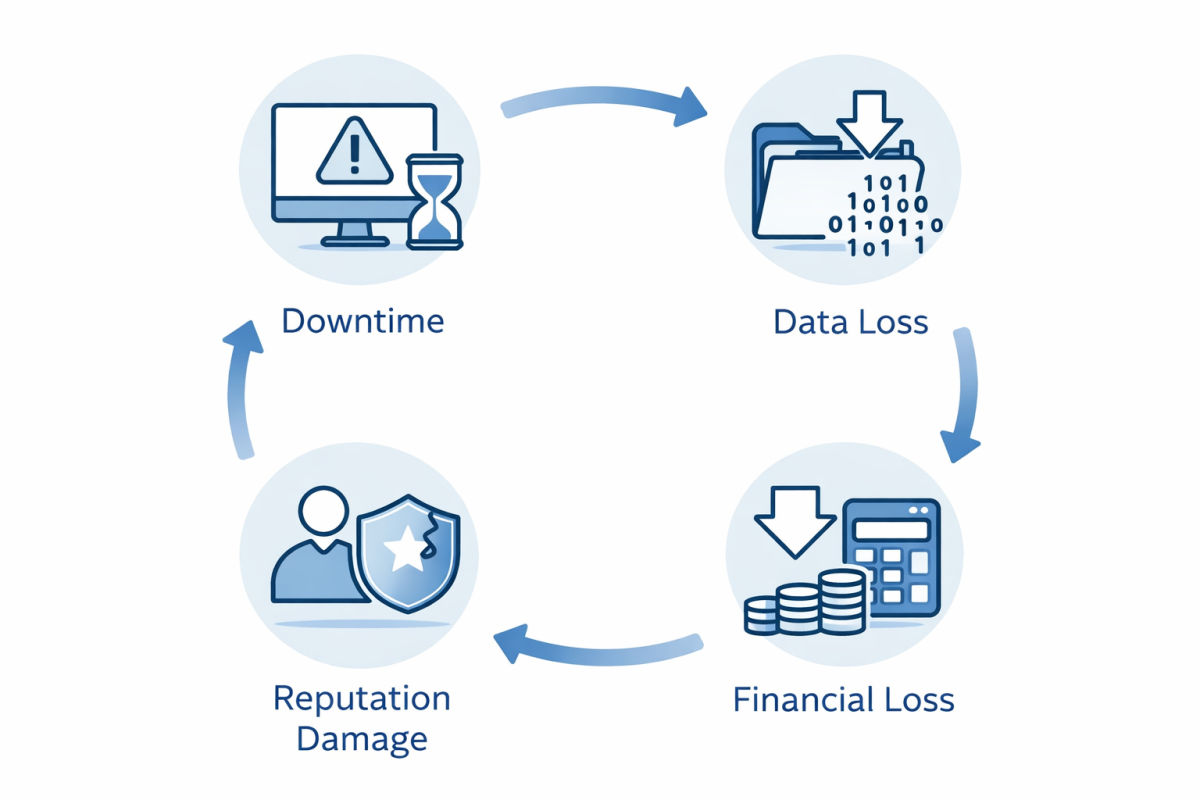
The Real Cost of a Cyber Attack on a SMB
Beyond the obvious financial losses, a cyber incident causes cascading damage that many business owners underestimate:
- Operational downtime while systems and access are investigated and restored
- Legal obligations to notify affected customers under the Notifiable Data Breaches scheme
- Reputational damage that drives customers to competitors
- Lost productivity while systems are recovered
Insurance claims that can increase premiums or be denied if basic controls weren’t in place
5 Essential Cybersecurity Steps for local Businesses
1. Enable Multi-Factor Authentication (MFA) on Everything
MFA adds a second layer of verification — a code sent to your phone — so that even if a password is stolen, the attacker still can’t log in. Enable MFA on Microsoft 365, Google Workspace, banking portals, and any remote access tools. This step can prevent many account takeover attempts, especially when paired with strong sign-in policies.
2. Keep All Software Updated
Unpatched software is one of the most exploited attack vectors. Enable automatic updates for Windows, macOS, Microsoft 365, and all third-party applications. Your MSP can manage patching across your entire fleet automatically.
3. Train Your Team to Spot Phishing
Your staff are both your greatest vulnerability and your best defence. Regular security awareness training — ideally with simulated phishing exercises — dramatically reduces the risk of someone clicking a malicious link. Ask your MSP about ongoing security training programs.
4. Back Up Your Data Using the 3-2-1 Rule
Maintain at least three copies of your data, on two different media types, with one stored offsite (such as in a cloud backup service). Test your backups regularly. Many businesses only discover their backups were failing when they actually need them.
5. Use a Business-Grade Firewall and Endpoint Protection
Consumer-grade antivirus is insufficient for business use. Deploy enterprise endpoint detection and response (EDR) tools that can identify and stop threats in real time, even unknown malware variants.
How a MSP Strengthens Your Cyber Posture
A local Managed Service Provider doesn’t just fix your IT when it breaks — a great MSP acts as your outsourced IT security team. At Royal IT, we provide businesses with:
- 24/7 monitoring of your network and endpoints for suspicious activity
- Proactive patch management so vulnerabilities are closed before attackers exploit them
- Security awareness training tailored to your industry
- Incident response planning so you know exactly what to do if the worst happens
- Cyber insurance advisory and compliance support
Curious about what your current security posture looks like? Request a cyber security assessment with our team — we’ll identify your risks and give you a clear action plan.
Staying Compliant: Australian Cybersecurity Obligations
Australian businesses have legal obligations under the Privacy Act 1988 and the Notifiable Data Breaches (NDB) scheme. If your business holds personal information and suffers a data breach, you may be required to notify affected individuals and the Office of the Australian Information Commissioner (OAIC). Fines for non-compliance can reach hundreds of thousands of dollars.
An MSP can help you establish data handling policies, conduct risk assessments, and ensure you have the documentation needed to demonstrate compliance.
Next Steps for Your Business
Cybersecurity doesn’t have to be overwhelming. Start with the basics — MFA, patching, backups, and staff training — and build from there. A capable local MSP can take most of this off your plate so you can focus on running your business.
Read next: Why Businesses Are Switching to Managed IT Services in 2025 | What is a Managed Service Provider?
| 🔒 Ready to protect your business? Contact Royal IT today for a cyber security review. |